Neurofeedback Therapy for Improved Brain Function and Self-Regulation
Neurofeedback is a noninvasive, brain-based intervention that helps individuals learn to regulate patterns of activity within the brain and central nervous system. Through real-time feedback, the brain practices developing healthier, more flexible patterns associated with relaxation, attention, activation, and emotional regulation.
How Does Neurofeedback Work?
Neurofeedback training measures brainwave activity and provides immediate feedback when the brain moves toward a desired pattern. With practice, this learning process may help the brain become more adaptable and improve its ability to respond to stress, cognitive demands, and emotional experiences.
Neurofeedback offers a way to improve overall brain functioning without the use of medication to help alleviate symptoms. It has shown promising results for the treatment of many disorders and longevity in maintaining progress after treatment has ended. Neurofeedback is safe to use with children through adults.
The goal of neurofeedback is to strengthen brain flexibility and self-regulation—not simply to promote relaxation. Training may help the brain shift more effectively between calm, focused, and activated states based on the demands of the situation.
Individual outcomes vary, and neurofeedback should not replace appropriate medical or mental health care. A personalized assessment can help determine whether neurofeedback may be appropriate for an individual’s symptoms and treatment goals.
Learn More About Neurofeedback
For additional information about neurofeedback, professional standards, research, and provider qualifications, visit:
The office offers Z-score training neurofeedback that first starts with Quantitative electroencephalography (QEEG), commonly referred to as “brain mapping.” The QEEG provides a visual of current brain wave functions that paired with a clinical interview helps develop a treatment plan that focuses on training regulating the brain wave functions associated with the symptoms being experienced.
Neurofeedback involves wearing a cap with several electrodes/sensors being placed on your scalp and ear lobes to detect brain wave activity. Your brainwaves are measured and displayed on the computer screen and through instruction, you can learn to train down or train up certain brainwaves associated with your identified symptoms.
The length of treatment can vary, but most effective neurofeedback typically takes 30-40 training sessions. Some conditions may take longer. Follow-up QEEGs is completed after every 10 neurofeedback training sessions to assess changes in symptoms and brain wave function.
Lifestyle habits are important as well including diet, sleep habits, and regular self-care to manage daily stress. Neurofeedback is considered generally to be safe and non-intrusive. This service is only offered in person at all three locations.
Neurofeedback has been used for treating a variety of symptoms and has been found effective in treating the following conditions:
- Anxiety
- Attention-Deficit/Hyperactivity Disorder
- Autism Spectrum Disorders
- Bipolar Disorder
- Chronic Pain
- Compulsive Behaviors
- Depression
- Insomnia
- Learning Disabilities
- Migraines and headaches
- Compulsive Behaviors
- Post-traumatic Stress Disorder
- Obsessive-Compulsive Disorder
- Traumatic Brain Injuries
1) Schedule an initial phone consult to discuss neurofeedback services.
The initial phone interview will assist you in determining neurofeedback is a good match for your symptoms.
2) Assessment and QEEG
The first appointment will have you complete several assessments to help determine your areas of strengths and potential areas that need training. A Board Certified Neurofeedback clinician will be collect several EEG recordings in the 2nd half of the session. These recordings will be analyzed and used with the assessments to create an individualized treatment plan for training the areas of the brain that are dysregulated. The appointment lasts 1 hour.
3) Review of Results and Training
This is a 1-hour session where the EEG results and treatment training plan is reviewed, followed by a 20-30 minute neurofeedback training.
4) Neurofeedback training sessions last 1 hour.
The neurofeedback training lasts 20-30 minutes followed by 30-minute psychotherapy focusing on teaching regulation skills. Most people will complete 20-30 training sessions. Some people may do fewer or some may do more training sessions, it’s individualized towards your goals and response to the training.
5) New EEGs are collected after every 10 training sessions to reassess your progress.
You will get a revised treatment training plan each time with adjustments based on your goals and response to the neurofeedback training.
Neurofeedback can be done as often as twice a day multiple days a week with a break for rest between training sessions. Most clients will do 1-2 training sessions a week. Neurofeedback training works best with consistent training for the brain and it’s best to not space the training appointments further than 2 weeks apart.
- QEEGs are $600 each
- QEEG comprehensive reports are $600 each
- Neurofeedback training sessions are $190 each
Counseling Services for Individuals, Couples and Families
Counseling provides a supportive and confidential space to address emotional, behavioral, mental health, and relationship concerns. At Amanda Martin LPC, PLLC, sessions are provided by licensed clinicians and are personalized to each client’s experiences, symptoms, strengths, and treatment goals.
We offer individual counseling, couples counseling, and family therapy for clients seeking greater emotional well-being, healthier relationships, and improved quality of life.
Amanda Martin LPC, PLLC offers several evidence-based and trauma-informed treatment approaches. Depending on your needs, these counseling modalities may be used independently or integrated into a personalized treatment plan.
Your clinician will work collaboratively with you to identify treatment goals and determine which therapeutic approach may best support your needs. Counseling does not follow a one-size-fits-all model; treatment recommendations are based on your current symptoms, history, strengths, preferences, and goals.

How Counseling Can Help
Counseling may help clients:
- Reduce emotional distress
- Improve emotional and behavioral regulation
- Develop healthier coping and stress-management skills
- Increase self-awareness and confidence
- Strengthen communication and relationship skills
- Resolve interpersonal or family conflict
- Improve overall well-being and enjoyment of life
- Create meaningful and sustainable changes
Counseling may also support individuals experiencing anxiety, depression, trauma, chronic stress, grief, relationship difficulties, behavioral concerns, and other mental health challenges.
What to Expect From Counseling
Standard counseling appointments are approximately 50 minutes. The recommended frequency of appointments and overall length of treatment vary depending on:
- The severity and duration of symptoms
- Your individual, relationship, or family goals
- Current stressors and support systems
- Progress throughout treatment
- The therapeutic approach being used
Some clients benefit from short-term, goal-focused counseling, while others may benefit from longer-term support. Treatment recommendations are reviewed collaboratively and may be adjusted as your needs change.
In-Person and Virtual Counseling Appointments
Counseling services are available at all three Amanda Martin Counseling locations. Clients may choose from:
- In-person counseling
- Secure virtual counseling appointments
- Individual therapy
- Couples counseling
- Family therapy
Virtual counseling availability may be subject to clinician licensure requirements and the client’s physical location at the time of the appointment.
Additional Counseling Resources
To learn more about professional counseling, marriage and family therapy, and mental health care, visit:
Counseling appointments are $190 each.
EMDR Therapy for Trauma, Mental Health, and Peak Performance
Eye Movement Desensitization and Reprocessing (EMDR) therapy is an evidence-based psychotherapy approach that helps people heal from traumatic, distressing, or overwhelming life experiences. EMDR therapy can also help athletes, performers, professionals, and other high-achieving individuals address performance blocks and strengthen confidence.
Amanda Martin LPC, PLLC offers EMDR therapy for mental health concerns and peak-performance goals through in-person and virtual appointments.
What Is EMDR Therapy?
Distressing experiences can sometimes remain stored in ways that cause the mind and body to react as though a past event is still happening. EMDR therapy uses a structured, eight-phase treatment approach to help the brain reprocess these experiences and develop more adaptive responses.
During EMDR processing, the clinician may use bilateral stimulation through guided eye movements, alternating taps, or sounds. While maintaining a dual focus on the memory and the present moment, clients are invited to notice thoughts, emotions, physical sensations, and associations that emerge.
The goal is not to erase the memory. Instead, EMDR therapy is intended to reduce the memory’s emotional and physiological intensity so that it can be recalled without producing the same overwhelming response.
The goal of EMDR therapy is to help maintain a present awareness in situations that trigger the painful memory without activating a threatening response in your body. There is not a set number of sessions for EMDR therapy, but symptom reduction is typically reported after 10-12 sessions. This type of therapy can be done in-office or through virtual appointments. EMDR therapy is offered at all three locations.
If you are seeking additional information on researchers on EMDR therapy, visit www.emdria.org.
EMDR therapy is widely associated with treating trauma and post-traumatic stress. Depending on a client’s history, symptoms, readiness, and treatment needs, it may also be incorporated into counseling for:
- Trauma and post-traumatic stress
- Anxiety, fear, and panic
- Depression and negative beliefs
- Grief and loss
- Distressing childhood experiences
- Relationship trauma
- Emotional dysregulation
- Performance anxiety
- Phobias and avoidance
- Chronic stress
- Painful or intrusive memories
- Low self-confidence
- Medical or injury-related trauma
Treatment recommendations are individualized, and EMDR may be used independently or alongside other evidence-based counseling approaches.
There is no predetermined number of EMDR therapy sessions. Some clients may notice symptom improvement within approximately 10–12 sessions, while others may need fewer or more sessions. Treatment length depends on several factors, including:
- The nature and severity of symptoms
- Whether the concern involves a single event or multiple experiences
- The client’s current stability and available support
- The presence of complex or developmental trauma
- Treatment goals and readiness for memory processing
EMDR therapy includes assessment, preparation, stabilization, memory processing, and progress evaluation. Your clinician will work collaboratively with you to determine an appropriate pace and treatment plan. Individual outcomes cannot be guaranteed.
In-Person and Virtual EMDR Therapy
EMDR therapy is available at all three Amanda Martin LPC, PLLC locations. Clients may participate through:
- In-person EMDR therapy
- Secure virtual EMDR appointments
- EMDR therapy for mental health concerns
- Peak-performance EMDR for athletes and performers
Virtual services are subject to clinical appropriateness and professional licensure requirements based on the client’s physical location during the appointment.
EMDR therapy appointments are $190 each.
Peak-Performance EMDR Therapy
Peak-performance EMDR applies EMDR principles to performance challenges rather than focusing exclusively on mental health symptoms. It may benefit athletes, equestrians, musicians, performers, executives, public speakers, and other individuals who feel unable to perform consistently at their demonstrated skill level.
Peak-performance EMDR may help address:
- Performance anxiety
- Fear of failure or making mistakes
- Mental blocks and “freezing” under pressure
- Loss of confidence following an injury or setback
- Difficulty recovering from a disappointing performance
- Negative self-talk and self-doubt
- Anxiety about returning to competition
- Difficulty maintaining focus under pressure
- Past experiences that interfere with present performance
Treatment may include identifying the experiences or beliefs contributing to the performance block, strengthening internal resources, processing relevant memories, and mentally rehearsing effective future performance.
Learn more through the EMDRIA performance-enhancement resources and the EMDR Therapy and Sports Performance podcast.

How Can Peak-Performance EMDR Help Me?
Peak-performance EMDR therapy can help athletes, performers, executives, public speakers, and other high-achieving individuals overcome mental barriers and perform more consistently under pressure. This specialized approach uses EMDR therapy techniques to address past experiences, negative beliefs, anxiety, or self-doubt that may interfere with reaching your full potential.
Benefits of Peak-Performance EMDR Therapy
Peak-performance EMDR may help you:
- Increase self-awareness
- Develop more positive and effective self-talk
- Strengthen confidence in your abilities
- Reduce performance anxiety and fear of failure
- Recover from mistakes, injuries, or disappointing performances
- Improve focus during high-pressure situations
- Execute practiced skills on demand
- Overcome mental blocks or feelings of being “stuck”
- Activate a confident performance mindset
- Mentally rehearse successful future performances
EMDR is a comprehensive therapeutic model that can support performance in many areas of life. Treatment is personalized to your goals, experiences, strengths, and the specific situations that interfere with your performance.
Who Can Benefit From Peak-Performance EMDR?
Peak-performance EMDR may be appropriate for:
- Athletes and equestrians
- Musicians, actors, and dancers
- Public speakers
- Students and test takers
- Executives and business professionals
- First responders
- Individuals preparing for auditions, competitions, or major events
You do not need to have a mental health diagnosis to benefit from performance-focused EMDR. However, when trauma, anxiety, or another mental health concern contributes to the performance difficulty, your clinician may recommend integrating peak-performance work into a broader treatment plan.
In-Person and Virtual Peak-Performance EMDR
Peak-performance EMDR therapy is offered in person at all three Amanda Martin LPC, PLLC locations and through secure virtual appointments when clinically appropriate. Your clinician will collaborate with you to identify performance barriers, strengthen helpful internal resources, and develop a personalized plan for performing with greater confidence and consistency.
Learn more about EMDR therapy and performance enhancement through the EMDR International Association.
In-office and virtual 50-minute appointments are $190 each.
Travel charge to the location of performance within 25 miles is $75 and 26-50 miles is $125 plus the appointment fee.
For more information about EMDR therapy, research, treatment expectations, and qualified practitioners, visit:
Equine-assisted psychotherapy is an experiential mental health service that incorporates purposeful, ground-based interactions with horses into the counseling process. Amanda Martin LPC, PLLC provides equine-assisted therapy informed by the Eagala and Natural Lifemanship service models and guided by trained mental health and equine professionals.
What Is Equine-Assisted Psychotherapy?
Equine-assisted psychotherapy combines experiential, animal-assisted, relational, and integrative approaches to mental health treatment. Instead of relying exclusively on traditional talk therapy, clients can explore emotions, behaviors, relationships, personal boundaries, and patterns of connection through experiences involving horses.
This service is entirely ground-based. Clients do not ride the horses, and no horseback-riding experience is required.
The therapeutic experience is individualized and may include observing horses, interacting with them, completing activities, or reflecting on what occurs naturally during the session. Clients are supported in developing their own insights and meaning rather than being given a predetermined interpretation of the horse’s behavior.
Amanda Martin LPC, PLLC incorporates principles from established equine-assisted service models.
The Eagala Model is a structured, collaborative model of equine-assisted psychotherapy involving a mental health professional, an equine specialist, and horses in a ground-based environment. The model emphasizes experiential, client-centered work without riding.
Natural Lifemanship is a relationship-focused approach to equine-assisted services informed by the science of relationships, connection, trauma, and nervous-system regulation.
Additional information is available from:
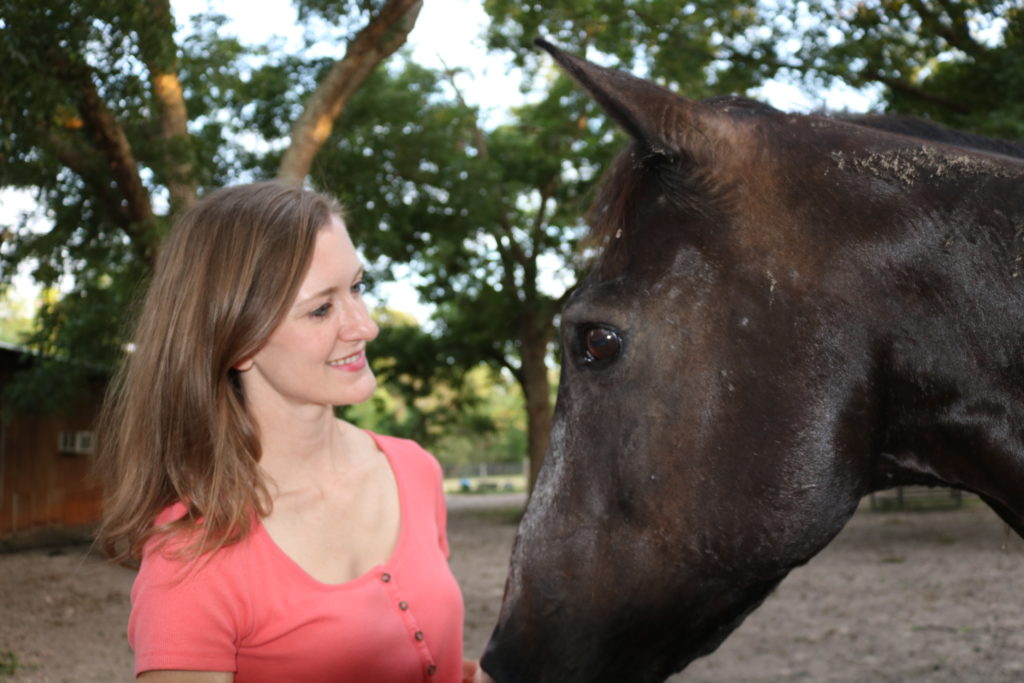
Horses are highly responsive to movement, body language, boundaries, emotional energy, and changes within their environment. Their responses can create opportunities for clients to increase awareness of their internal experiences and explore how they approach relationships, safety, trust, and connection.
Equine-assisted psychotherapy may help clients:
- Increase emotional and behavioral awareness
- Explore trauma and distressing life experiences
- Identify patterns that contribute to feeling stuck
- Strengthen emotional regulation
- Develop healthier boundaries
- Improve communication and relationship skills
- Build trust, confidence, and self-efficacy
- Explore physical and emotional safety
- Increase empathy and connection
- Practice new responses in the present moment
The horse is viewed as an active partner with individual needs, preferences, and boundaries—not as a tool. All interactions prioritize the physical and emotional well-being of the client, horse, and professional team.
A Collaborative Equine-Assisted Therapy Team
Equine-assisted psychotherapy uses a collaborative team approach that may include:
- The client
- One or more horses
- A licensed mental health professional
- A trained equine specialist
The mental health clinician supports the client’s therapeutic process, treatment goals, and emotional safety. The equine specialist contributes expertise in horse behavior, the environment, and physical safety. Horses participate as responsive partners within the therapeutic experience.
Through this collaborative process, clients may discover new perspectives, recognize relationship patterns, and experiment with different ways of responding. Change can develop through experience, reflection, and the client’s own meaning-making process.
Equine-assisted psychotherapy is offered at the Special CHEERS location and Southern Star Farms location by appointment. Because sessions take place outdoors, availability is limited to designated days and times and is subject to weather, site conditions, and horse availability.
Equine-assisted psychotherapy individual sessions (50 minutes) are $190 for each session. Equine-assisted group therapy (50 minutes) are $50 per person with a 4 person minimum.
Amanda Martin, PhD, LMFT-S, LPC, BCN-L, is an EMDRIA Certified EMDR Therapist™, EMDRIA Approved Consultant™, and EMDRIA Approved Trainer™. She provides professional EMDR consultation and advanced training for therapists seeking to strengthen their clinical skills and pursue EMDRIA credentials.
EMDR Consultation for Certification
Individual and group EMDR consultation is available for:
- EMDR-trained therapists working toward EMDRIA Certified EMDR Therapist status
- Certified EMDR therapists pursuing EMDRIA Approved Consultant status as Consultants-in-Training
- Clinicians seeking guidance in case conceptualization, treatment planning, client preparation, and the application of EMDR therapy with specific populations
Consultation is offered in person and virtually at all three practice locations. To review current EMDR certification and consultation requirements, visit the EMDR International Association (EMDRIA).
EMDR Consultation Fees
- Individual consultation: $100 per 60-minute session
- Group consultation: $75 per person per 60-minute session
Please contact Amanda Martin Counseling to schedule an individual consultation or inquire about upcoming EMDR consultation groups.
EMDR Training, Seminars, and Webinars
Amanda offers professional training for therapists, counseling practices, agencies, and community organizations. Educational seminars and webinars are available in person and virtually, with frequently requested topics including:
- EMDR therapy with specific populations
- Preparing clients for EMDR therapy
- Trauma-informed practices for agencies serving trauma-affected communities
- Ethics in mental health practice
- Clinical applications and adaptations of EMDR therapy
Upcoming workshops and registration links are listed under the Professional Training and Team-Building Equine-Assisted Retreats section of the How We Help tab.
Additional course information and registration are available through CompassionWorks.
Upcoming Training
Upcoming trainings and links to workshop registration can be found on the How We Help Tab under Professional Training and Team-Building Equine-Assisted Retreats.
Information on registering for the courses is at www.compassionworks.com
Customized professional training is available for counseling practices, agencies, schools, nonprofits, and other organizations. Training fees vary according to the topic, format, length, and size of the group.
Please contact the office to discuss consultation availability, customized training topics, and rates.
Equine-Assisted Team-Building Retreats and Professional EMDR Training
Unlock Your Team’s Potential with Equine-Assisted Team-Building Retreats
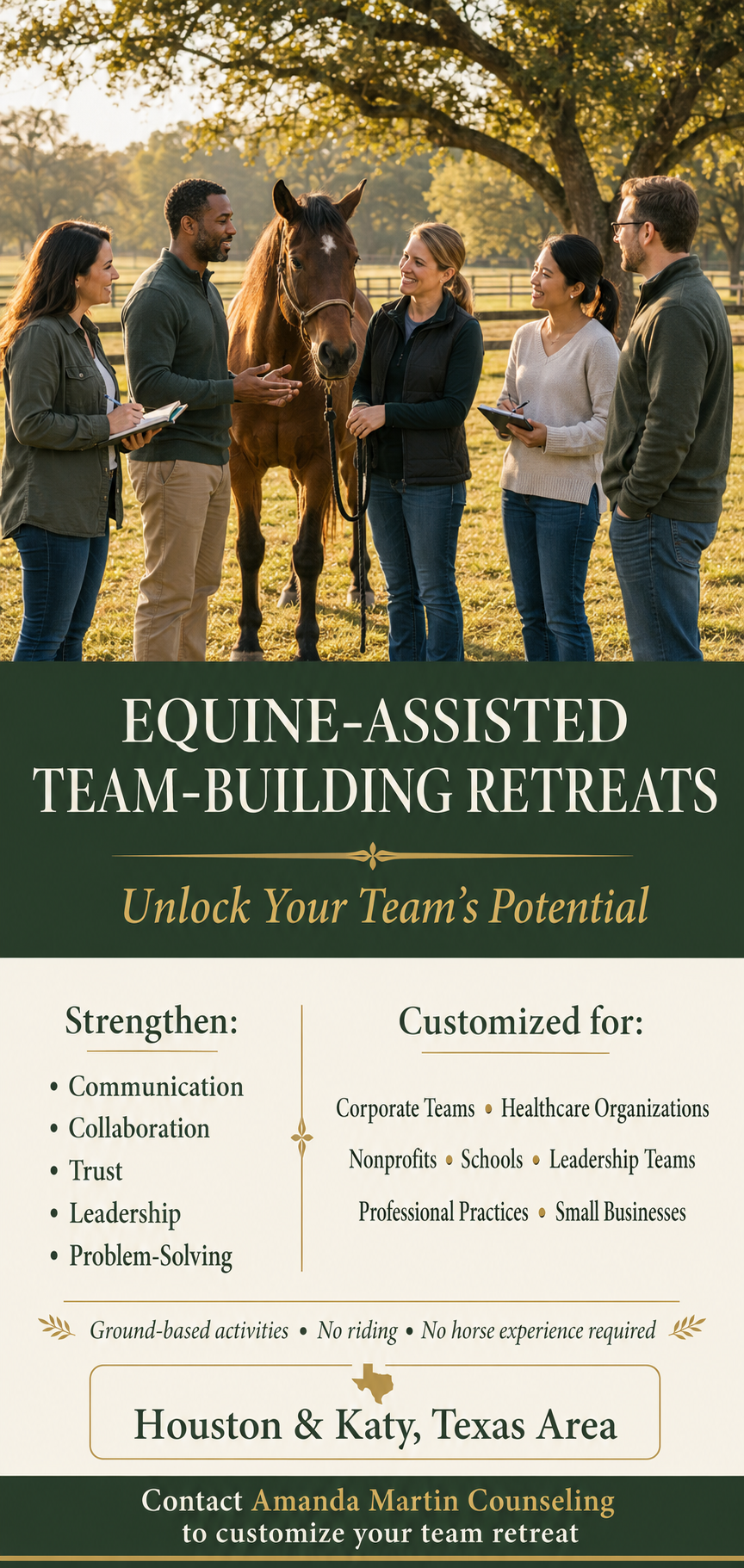
Strengthen communication, collaboration, trust, and problem-solving through an engaging equine-assisted team-building retreat in the Houston and Katy, Texas, area. These experiential retreats allow teams to step away from daily demands, reconnect with one another, and develop practical skills in a peaceful, natural setting.
Through structured, ground-based activities with horses, participants can explore communication patterns, leadership styles, boundaries, teamwork, and group dynamics in real time. No horseback riding or previous horse experience is required.
Equine-assisted team-building retreats can be customized for:
- Businesses and corporate teams
- Mental health and healthcare organizations
- Nonprofit and community agencies
- School and university groups
- Leadership teams
- Professional practices and small businesses
Give your team an opportunity to unplug, recharge, and build stronger working relationships through meaningful experiential learning. Contact Amanda Martin Counseling to discuss retreat options, group size, scheduling, and customized team-building goals.
Upcoming Continuing Education Workshops
Amanda Martin, PhD, LMFT-S, LPC, BCN-L, is an EMDRIA Certified EMDR Therapist™, EMDRIA Approved Consultant™, and EMDRIA Approved Trainer™ offering professional EMDR therapy education for counselors and other mental health professionals.
Live Online EMDR Trainings
- EMDR History and Preparation: A Step-by-Step Guide for Preparing Clients for EMDR — September 12, 2026
- EMDR Therapy: Equine-Assisted Workshop — October 24, 2026
- Using EMDR Therapy in Short-Term Treatment Programs — December 5, 2026
On-Demand EMDR Trainings
- EMDR Therapy: History and Preparation On-Demand Workshop
- Using EMDR Therapy With Neurodivergent Clients On-Demand Workshop
- EMDR Therapy: Equine-Assisted On-Demand Workshop
These professional EMDR workshops provide practical education in client preparation, trauma-informed treatment, neurodiversity-affirming adaptations, equine-assisted therapy, and the integration of EMDR therapy into short-term treatment programs.
Visit the EMDR International Association to learn more about EMDR therapy, professional credentials, and continuing education requirements. Additional courses, registration information, eligibility requirements, and pricing are available through CompassionWorks.
Live Counseling and Ethics CE Training
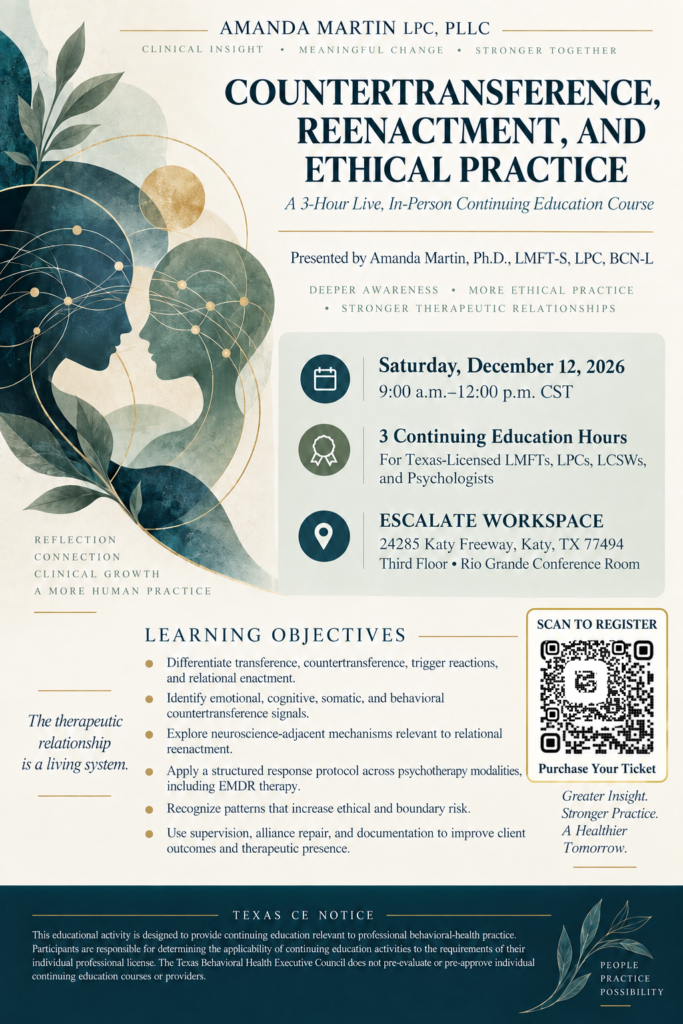
- Countertransference, Reenactment and Ethical Practice (3 hours) – December 12, 2026
- Time: 9:00 a.m.–12:00 p.m. CST
- Location: Escalate Workspace, 24285 Katy Freeway, Katy, TX 77494, Third Floor—Rio Grande Conference Room
- Space is limited! Register using the Register Now Button.
Equine-assisted team-building offers an engaging, experiential way to improve workplace communication, leadership, trust, collaboration, and problem-solving. Located on 240 beautiful acres in the West Houston area, these customized retreats combine ground-based activities with a herd of 15 horses, outdoor mindfulness exercises, and guided team reflection.
Horses are intuitive and highly responsive to movement, behavior, and changes in their environment. Their immediate, nonjudgmental responses can help participants become more aware of communication patterns, leadership styles, boundaries, and team dynamics. Unlike traditional corporate team-building activities, working alongside horses encourages teams to remain present, communicate clearly, and adapt together.
This strength-based experience gives businesses, nonprofit organizations, healthcare professionals, schools, and leadership teams an opportunity to step away from daily demands, reconnect, and develop practical skills that can transfer to the workplace.
Benefits of Equine-Assisted Team-Building
Improved Team Communication
Horses respond to clear, consistent communication and coordinated action. Guided activities help team members practice listening, giving directions, reading body language, and working collaboratively toward shared goals.
Greater Trust and Connection
Trust is essential in both horse-human interactions and successful workplace relationships. Experiential exercises can help participants strengthen mutual trust, recognize individual strengths, and build more meaningful professional connections.
Leadership Development
Working with horses creates opportunities to explore different leadership approaches. Participants can learn how confidence, clarity, flexibility, emotional awareness, and nonverbal communication influence their ability to guide and support others.
Creative Problem-Solving and Adaptability
Completing challenges with an equine partner encourages teams to think creatively, adjust their strategies, and remain flexible. These problem-solving skills can translate directly to workplace projects, leadership responsibilities, and organizational change.
Stress Reduction and Team Resilience
Time outdoors with horses can offer a restorative break from workplace demands. Mindfulness exercises and nature-based activities encourage participants to slow down, become more present, and explore healthier responses to stress.
What to Expect During Your Retreat
Each equine-assisted team-building retreat is facilitated by trained professionals and customized around the team’s identified needs, strengths, and goals. Activities may include:
- Leadership challenges: Collaborate to guide a horse through an activity or obstacle.
- Nonverbal communication exercises: Explore how body language, positioning, and movement affect communication.
- Collaborative problem-solving: Develop and revise strategies while working toward a shared objective.
- Outdoor mindfulness exercises: Practice present-moment awareness and stress-management skills in a natural setting.
- Team reflection discussions: Connect observations from the activities to communication, relationships, and goals in the workplace.
No previous horse experience is needed. All interactions are completed from the ground, and no horseback riding is involved. Retreats are held outdoors and are subject to appropriate weather conditions.
Retreat Length and Group Size
Equine-assisted corporate and organizational retreats may be scheduled in blocks ranging from four to eight hours.
- Group size: 4–20 participants
- Half-day retreat: 4 hours
- Full-day retreat: 8 hours
- Location: 240-acre equine facility in the West Houston area
- Format: Outdoor, ground-based activities with no riding
- Schedule an initial planning consultation.
A one-hour intake meeting is held with team leaders or managers to identify organizational goals, participant needs, and the preferred timeframe. - Choose the retreat date and format.
Select a half-day or full-day experience and review the location, schedule, participation guidelines, and safety procedures. - Participate in the retreat.
Your team completes customized equine-assisted activities, mindfulness exercises, and facilitated discussions during the reserved block of time. - Complete a post-retreat evaluation.
Participants provide feedback about their experience, learning, and opportunities for applying insights within the workplace.
Contact Amanda Martin Counseling today to schedule an initial consultation and begin planning your equine-assisted team-building retreat in West Houston.
- Schedule an initial planning consultation.
- Half-day retreat for 4–10 participants: $3,000
- Full-day retreat for 4–10 participants: $6,000
Contact Amanda Martin Counseling for pricing and scheduling information for groups of 11–20 participants or to discuss a customized retreat experience.
Amanda Martin, PhD, LMFT-S, LPC, BCN-L, is an EMDRIA Certified EMDR Therapist™, EMDRIA Approved Consultant™, and EMDRIA Approved Trainer™. She provides professional EMDR education through live webinars, in-person workshops, and on-demand courses offered by CompassionWorks.
Private group training is available for advanced EMDR workshops and EMDR basic training. Counseling practices, treatment programs, agencies, and other organizations may contact the office to discuss customized topics, scheduling, group eligibility, and pricing.
Learn more about EMDR professional standards and credentials through the EMDR International Association
Intensive Services
Intensives are blocks of therapy services offered by appointment only. Intensives may include a 4-hour block, 1 day (8 hours), or 2-3 days (2-3 days of 8-hour days) that focus on providing clinical intervention on a specific area to help with quick symptom relief.
Intensives may include more than one type of therapeutic service or focus on one type of service like EMDR therapy. Most often, intensives are scheduled for people who travel frequently or have certain jobs that hinder being consistent with routine appointments.
Intensive therapy appointments may include one or all of the types of services provided at each location. A thorough history and identified goals are established to set up a treatment plan of clinical interventions that will be used in the block of time. The intensives do incorporate a holistic approach that includes clinical interventions, self-care planning, and healthy life and eating habits.
While intensives can be very helpful in reducing symptoms, there are follow-up appointments recommended with regular counseling to help maintain the progress.

- A 4-hour block is $760.
- An 8-hour block is $1500.
- A 2-day block is $3000.
HeartMath
All three office locations offer heart rate variability training using a HeartMath device. Heart rate variability helps to improve emotional wellbeing and regulation of the autonomic nervous system that creates a physiological coherence of harmony in our mind, emotions, and body. This service is only offered in the office for in-person appointments and is often used in conjunction with practicing skills for homework three times a day for 5-10 minutes.
Improving heart rate variability has been shown to enhance physiological resilience, behavioral flexibility, and adaptation to life stress. Heartmath is used in the office as a clinical intervention in conjunction with psychotherapy and to help build awareness of coherence between mind and body.
HeartMath is included in the counseling session rate at $190 each.